

Recently, Prof. Shuai Dong’s team at the School of Physics, Southeast University, has made new progress in the study of unconventional collinear magnets and their magnetoelectric coupling effects. This related work, entitled “Ferroelectric Switchable Altermagnetic-like Compensated Ferrimagnets with Charge Ordering”,has been published in the Journal of the American Chemical Society.
Magnetoelectric coupling provides an important pathway toward the development of low-power, high-density, and nonvolatile information storage devices. In recent years, the emergence of novel unconventional collinear magnets, represented by altermagnets and fully compensated ferrimagnets, has brought new opportunities to this field. These materials combine the zero net magnetization of antiferromagnets with spin-splitting characteristics analogous to ferromagnets. In altermagnets, spin splitting is governed by symmetry operations between magnetic sublattices, resulting in momentum-dependent alternating spin splitting and unique anisotropic transport properties. In contrast, fully compensated ferrimagnets exhibit Zeeman-type spin splitting throughout the entire Brillouin zone due to the complete breaking of sublattice symmetries, leading to higher spin polarization. However, current studies on electrically controlled spin splitting are largely limited to a single mechanism, making it challenging to simultaneously achieve high spin polarization and pronounced transport anisotropy.
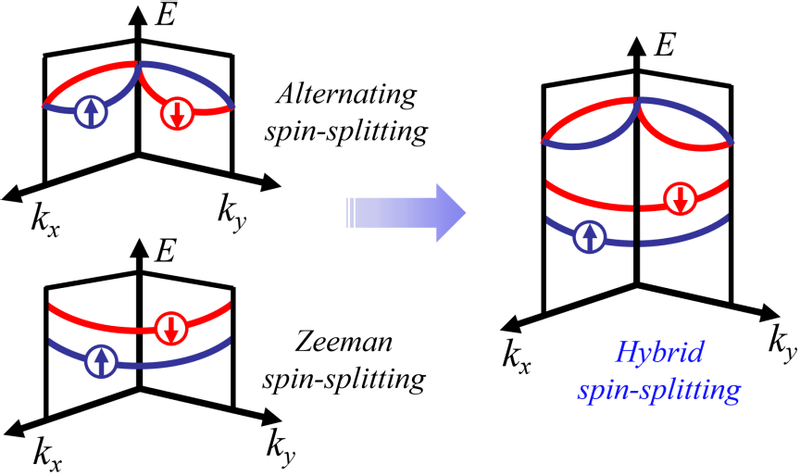
To address this challenge, Prof. Shuai Dong’s team proposed a strategy to enhance the functionality of unconventional collinear magnets by introducing additional degrees of freedom, such as charge ordering and ferroelectricity. Based on the theoretical modeling, first-principles calculations, and symmetry analysis, the team predicted a hybrid spin-splitting mechanism in monolayer Fe3O5, originating from the synergistic interplay between alternating and Zeeman-type spin splittings. This mechanism combines anisotropic transport and high spin polarization, while enabling fully reversible electrical control through ferroelectric polarization switching. The work provides a new pathway toward low-power, highly spin-polarized, and electrically tunable spintronic devices.
The first author of this paper is Xinyu Yang, a PhD studentat the School of Physics, Southeast University. Prof. Shuai Dong isthe corresponding author. Southeast University is the sole institution responsible for this work. This work was supportedby the National Key Research and Development Program of China and National Natural Science Foundation of China. This research work was supported by the Big Data Computing Center of Southeast University and the Center for Fundamental and Interdisciplinary Sciences of Southeast University.
Link:https://doi.org/10.1021/jacs.6c08853
