

On June 8, 2026, a research teams led by Professors Jinlan Wang and Chongyi Ling from the School of Physics at Southeast University made significant progress in establishing structure–performance relationships for catalytic materials. A physically grounded descriptor (Nμ(U)). Using only a few physically meaningful parameters, it quantitatively decouples the contributions of the intrinsic electronic structure and the applied electrode potential to the macroscopic performance of single-atom catalysts during CO2RR. This descriptor overcomes the limitations of conventional descriptors that primarily focus on static structural features and fail to capture the influence of operating conditions, providing a new framework for quantitatively predicting catalytic activity and selectivity under realistic electrochemical environments. The related research findings, titled “A Physically Grounded Descriptor Decoupling Intrinsic and External Contributions to CO2 Electroreduction over Single-Atom Catalysts” have been published in the Journal of the American Chemical Society (JACS), a top international chemistry journal.
The catalytic performance of a material arises from the interplay between the intrinsic properties of the catalyst and the reaction environment. Although atomistic structure-performance relations based on the intrinsic properties have been highly successful in explaining catalytic trends and facilitating catalyst discovery, they are fundamentally limited by their static nature. In electrochemical reactions, the applied potential serves as the primary driving force, continuously modulating interfacial species and charge distributions. As a result, the complex reaction energetics and kinetics cannot be accurately captured by descriptors based solely on intrinsic properties. How these intrinsic properties are dynamically reshaped by electrochemical potential, and how the two distinct contributions can be quantitatively decoupled within a unified theoretical framework, has remained a long-standing challenge.
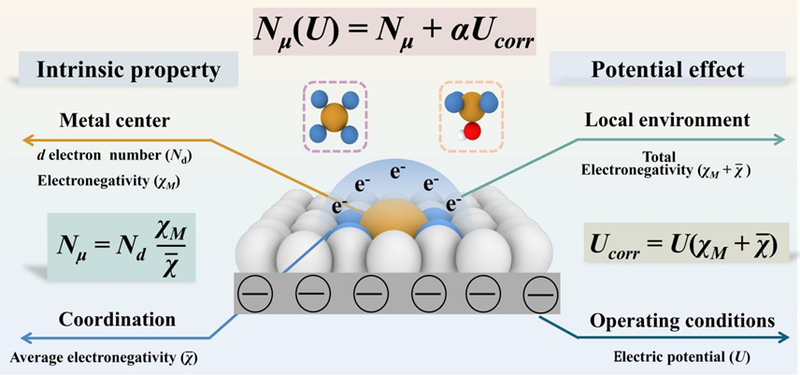
To address this challenge, the team developed a physically grounded descriptor, (Nμ(U)) on single-atom catalysts by first-principles calculations combined with physicochemical analysis. The descriptor decouples and quantitatively characterizes the respective contributions of the catalyst's intrinsic electronic structure and electrode potential-induced charge redistribution to the thermodynamics and kinetics of the CO2 reduction reaction (CO2RR) Coupled with microkinetic simulations, the descriptor accurately predicts the activity and selectivity of single-atom catalysts for CO2RR, with prediction trends in excellent agreement with experimental observations. Furthermore, it clearly delineates the CO2RR-dominated region, the strong competition region, and the hydrogen evolution reaction (HER)-dominated region, revealing the dynamic evolution of active sites from MN4–OH at low potentials to MN4 at more negative potentials. The study further reveals an intrinsic activity-selectivity-stability trade-off that activity is improved at the expense of selectivity and metal-site stability at more negative potentials. Based on only a few physically meaningful parameters, the descriptor establishes a quantitative link between intrinsic electronic structure, potential response, and reaction thermodynamics and kinetics, providing an interpretable and predictive framework for understanding and controlling electrocatalytic selectivity.
The first author of this paper is Yuxiao Meng, a PhD student at Southeast University. Professor Jinlan Wang and Professor Chongyi Ling from the School of Physics at Southeast University are the co-corresponding authors. This work was supported by the National Key Research andDevelopment Program of China and theNational Natural Science Foundation of China.
Link: https://doi.org/10.1021/jacs.6c09762
