

Prof. Yue Sun’s research group at Southeast University, in collaboration with Prof. Peng Zhang’s group at Nanjing University and Prof. Xianxin Wu’s group at the Institute of Theoretical Physics, Chinese Academy of Sciences, has published an important research article entitled “Evolution of the Intertwining Correlated Topological Phases in Iron-Based Superconductor Fe(Te,Se)” in the Journal of the American Chemical Society. The study reports the first direct observation of two distinct topological states in an electron-doped iron-based superconductor and demonstrates the crucial role played by strong electron correlations. This discovery establishes a clean and ideal platform for exploring the interplay between multiple topological superconducting states and Majorana modes.
Topological superconductors are considered promising material platforms for fault-tolerant quantum computing because they may host Majorana zero modes. Compared with artificially engineered heterostructures composed of topological insulators and conventional superconductors, intrinsic topological superconductors that simultaneously possess both topological and superconducting properties can provide a cleaner and more controllable system for fundamental studies. Iron-based superconductors represented by Fe(Te,Se) constitute such a natural platform: previous studies have revealed their topological surface states and Majorana zero modes, while theory has also predicted the existence of a topological Dirac semimetal bulk state.
To investigate this issue, the team successfully substituted Fe sites with Co atoms and grew high-quality electron-doped Fe1-xCoxTe0.6Se0.4 single crystals, effectively suppressing the influence of excess interstitial Fe. Angle-resolved photoemission spectroscopy (ARPES) measurements revealed that increasing Co concentration shifts the electronic bands toward lower energies. As a result, the topological-insulator surface state originally located near the Fermi level and the higher-energy topological Dirac semimetal state are successively tuned to the Fermi level (Figure 1). Importantly, at appropriate doping levels, both topological states can simultaneously participate in superconductivity, providing a new material platform for investigating multiple Majorana states and their mutual interactions.
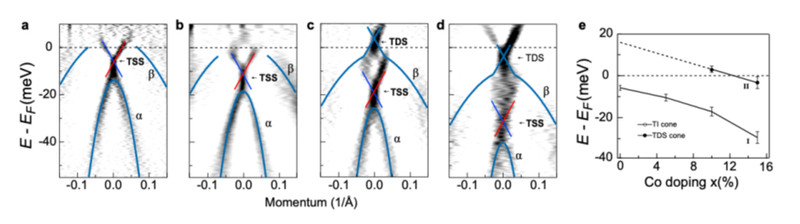
Figure 1.Evolution of the Dirac bands associated with the topological insulator (TI) and topological Dirac semimetal (TDS) states as a function of Co doping.
Prof. Yue Sun of Southeast University is the first author of the paper. Prof. Peng Zhang of Nanjing University and Prof. Xianxin Wu of the Institute of Theoretical Physics, Chinese Academy of Sciences, are the corresponding authors. The School of Physics, Southeast University, is the primary affiliation responsible for the work.
Link:https://pubs.acs.org/doi/10.1021/jacs.5c19995
