

Lead:
Recently, important progress in the study of non-Hermitian quantum physics and quasicrystalline systems has been achieved by the All-Optical Quantum Information Laboratory led by Prof. Peng Xue at the School of Physics, Southeast University, together with collaborators. Using a single-photon discrete-time quantum walk platform, the non-Hermitian Aubry-André-Harper (AAH) model was experimentally realized, and multiple phase transitions were systematically observed, including the metal-insulator transition, parity-time (PT) symmetry-breaking transition, and a novel spectral transition unique to discrete-time systems. The results reveal the intricate interplay among quasiperiodicity, non-Hermiticity, and Floquet discrete-time dynamics, providing a new experimental platform for exploring non-Hermitian topological physics and synthetic quantum matter. The work, entitled “Observation of Metal-Insulator and Spectral Phase Transitions in Aubry-André-Harper Models,” was published in Physical Review Letters.
Research Background
Localization phenomena in disordered and quasiperiodic systems constitute one of the central topics in condensed matter physics. Owing to its exact Aubry duality, the AAH model has become a paradigmatic framework for studying metal-insulator transitions and quasicrystalline physics. In this model, varying the strength of quasiperiodic modulation drives transitions between extended and localized states, giving rise to a characteristic metal-insulator transition. In recent years, the AAH model has been widely employed in the study of quasicrystals, topological phases, and Anderson localization, and has been experimentally explored in cold atoms, optical lattices, and photonic systems.
On the other hand, non-Hermitian systems, characterized by gain, loss, and nonreciprocal couplings, can exhibit exotic phenomena absent in conventional Hermitian systems, including parity-time (PT) symmetry breaking, non-Hermitian topological effects, and complex spectral structures. In non-Hermitian quasicrystalline systems, the interplay between quasiperiodicity and non-Hermiticity further leads to rich spectral topology and localization behaviors, making them an important frontier in contemporary non-Hermitian physics.
Recent theoretical studies have predicted that non-Hermitian AAH models can host not only PT-symmetry-breaking transitions, but also novel spectral phase transitions unique to discrete-time systems. However, experimental investigations remain limited due to the difficulty of simultaneously engineering quasiperiodic modulations and controllable non-Hermitian dynamics. In particular, systematic experimental observations of multiple phase transitions and their dynamical signatures are still lacking. Therefore, the experimental realization of non-Hermitian AAH models and the direct observation of metal-insulator transitions, PT-symmetry breaking, and novel spectral transitions are of significant importance for understanding transport, localization, and spectral topology in non-Hermitian quasicrystalline systems.
Photonic Quantum Walk Platform and Non-Hermitian Spectral Transitions
The research team first theoretically investigated the spectral evolution of the non-Hermitian AAH model under discrete-time Floquet dynamics. As shown in Fig. 1(a), the eigenvalue spectrum is distributed in the complex plane and undergoes significant evolution as the non-Hermitian parameter increases. In the weakly non-Hermitian regime, part of the quasienergy spectrum remains close to the unit circle. Once the non-Hermitian parameter exceeds a critical value, the system undergoes a PT-symmetry-breaking transition, and the eigenvalue spectrum gradually moves away from the unit circle into the complex plane. With a further increase of the non-Hermitian parameter, the system enters a novel spectral-transition regime unique to discrete-time systems, where all quasienergies completely detach from the unit circle, corresponding to a fully complexified spectrum. Such a spectral transition does not exist in conventional continuous-time non-Hermitian AAH models, revealing a new physical mechanism arising from the interplay between Floquet discrete-time dynamics and non-Hermitian effects.
To experimentally realize the above non-Hermitian quasicrystalline model, the research team constructed a single-photon discrete-time quantum walk platform. As shown in Fig. 1(b), single photons were generated through spontaneous parametric down-conversion, with one photon serving as the trigger signal and the other acting as the quantum walker. The quantum states were encoded using polarization and spatial-path degrees of freedom, while beam splitters, wave plates, and other polarization optical elements were employed to build a multi-step quantum walk network. This enabled the implementation of coin operations, position shifts, and non-Hermitian modulation in the Floquet evolution. The experimental platform allows high-precision quantum simulation of multiple phase transitions in the non-Hermitian AAH model and provides an experimental basis for investigating transport and spectral-topological properties in non-Hermitian quasicrystalline systems.
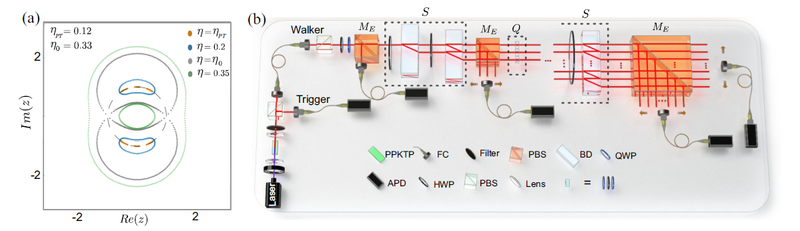
Figure 1: Spectral transitions in the non-Hermitian AAH model and the photonic quantum walk platform. (a) Evolution of the eigenvalue spectrum in the complex plane as the non-Hermitian parameter varies. (b) Schematic illustration of the single-photon discrete-time quantum walk experimental setup.
Experimental Observation of the Metal-Insulator Transition
After realizing the quantum simulation of the non-Hermitian AAH model, the research team first investigated the metal-insulator transition of the system in the Hermitian regime. As shown in Fig. 2(a)-(f), by tuning the system parameters, the dynamical signatures corresponding to extended, critical, and localized states were experimentally observed.
When the system is in the metallic phase, the quantum-walk wave packet rapidly expands with time and exhibits clear ballistic transport behavior, as shown in Fig. 2(a)(b). As the parameters approach the critical region, the expansion of the wave packet becomes suppressed, and the system displays critical behavior intermediate between extended and localized states, as shown in Fig. 2(c)(d). In the insulating phase, however, the wave packet remains localized near its initial position and cannot propagate over long distances, as shown in Fig. 2(e)(f). These distinct dynamical behaviors clearly reveal the metal-insulator transition in the system.
To quantitatively characterize the phase transition, the research team further measured the time evolution of the standard deviation of the quantum-walk probability distribution. As shown in Fig. 2(g), in the metallic phase, the standard deviation grows approximately linearly with time, corresponding to the continuous expansion of the wave packet. In contrast, in the insulating phase, the growth of the standard deviation is strongly suppressed, indicating localization dynamics. The experimental results agree well with theoretical predictions.
Furthermore, the research team scanned the entire parameter space and constructed the experimental phase diagram of the system. As shown in Fig. 2(h), the extended and localized phases are clearly distinguished in parameter space and separated by the self-dual line. The experimental results provide the first direct observation of the metal-insulator transition in the AAH model on a single-photon discrete-time quantum walk platform, offering a new experimental approach for studying localization physics in quasiperiodic systems.
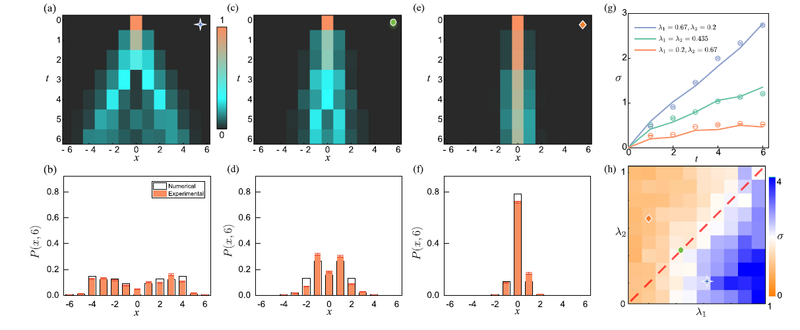
Figure 2: Experimental observation of the metal-insulator transition in the AAH model. (a)-(f) Experimental quantum-walk probability distributions in different parameter regimes, corresponding to extended, critical, and localized states, respectively. (g) Time evolution of the standard deviation of the probability distribution in different phases. (h) Experimentally measured phase diagram.
Experimental Observation of Non-Hermitian Spectral Transitions
After investigating the metal-insulator transition, the research team further explored the novel spectral-transition behavior in the non-Hermitian AAH model. As shown in Fig. 3(a), with increasing non-Hermitian parameter, the system first undergoes a PT-symmetry-breaking transition and subsequently enters a second spectral-transition regime unique to discrete-time systems. Beyond the second transition, all quasienergies completely detach from the unit circle, corresponding to a fully complexified spectrum.
To investigate the dynamical behavior near the second spectral transition, the research team further analyzed special localized eigenstates in the system. As shown in Fig. 3(b), before the second transition occurs, localized “lossless states” still exist in the system. Their corresponding quasienergies remain close to the real axis and exhibit clear spatial localization.
Based on this property, the initial state was further chosen as a localized state with large overlap with the lossless state, and its dynamical evolution was experimentally measured. As shown in Fig. 3(c), before the second spectral transition, the growth of the total probability is strongly suppressed, indicating that the evolution is dominated by the lossless state. In contrast, once the non-Hermitian parameter exceeds the second critical value, all initial states exhibit rapid amplification behavior, as shown in Fig. 3(d), corresponding to the emergence of imaginary parts in all quasienergies.
The experimental results provide the first direct observation of the novel spectral transition in the non-Hermitian AAH model and reveal the unique spectral-evolution behavior of Floquet discrete-time dynamics beyond conventional continuous-time systems.
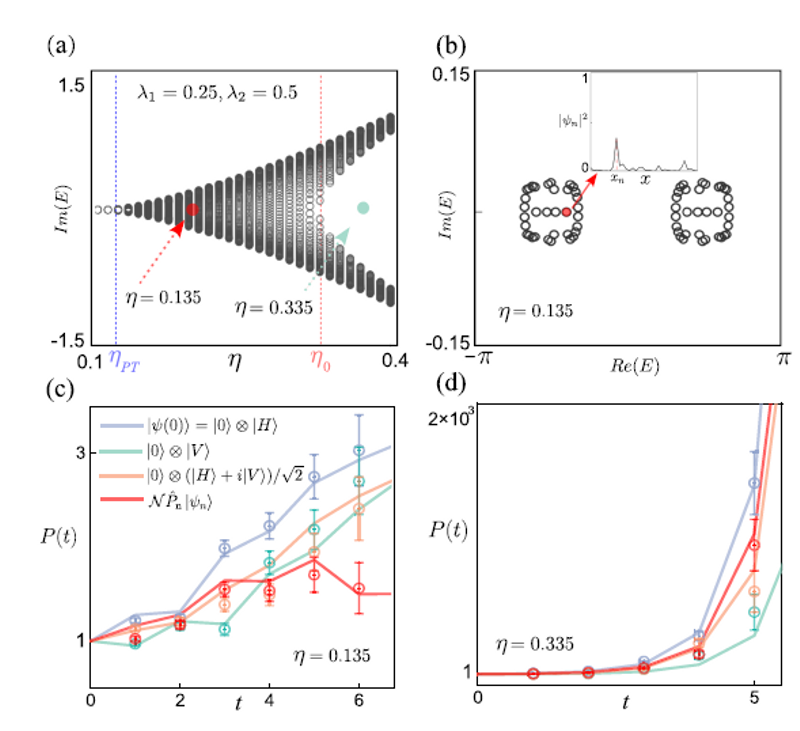
Figure 3: Experimental observation of spectral transitions in the non-Hermitian AAH model. (a) Evolution of the imaginary parts of the quasienergies as the non-Hermitian parameter varies. (b) Complex spectrum and spatial distribution of the localized lossless state before the second spectral transition. (c)(d) Time evolution of the total probability under different non-Hermitian parameters.
Summary and Outlook
This work was completed with the School of Physics at Southeast University as the primary affiliation by Prof. Peng Xue’s group from the All-Optical Quantum Information Laboratory at Southeast University. Dr. Quan Lin, a postdoctoral researcher at Southeast University, is the first author of the paper. Prof. Christopher Cedzich from Heinrich Heine University Düsseldorf and Prof. Qi Zhou from Nankai University are collaborators of this work. The research team realized the first quantum simulation of the non-Hermitian AAH model on a single-photon discrete-time quantum walk platform and systematically observed the metal-insulator transition, PT-symmetry-breaking transition, and a novel spectral transition unique to discrete-time systems. The experimental results reveal the rich interplay among quasiperiodicity, non-Hermiticity, and Floquet dynamics, and verify new physical mechanisms beyond conventional continuous-time models.
This work was supported by the National Key R&D Program of China, the National Natural Science Foundation of China, the Jiangsu Basic Research Program, and the China Postdoctoral Science Foundation.
Link: https://journals.aps.org/prl/abstract/10.1103/tz2n-lqxx
