

Recently, the research team led by Professors Jinlan Wang and Chongyi Ling from the School of Physics, Southeast University, has made significant progress in predicting the performance of experimental-scale nanoparticles. The related findings, titled “Mechanism- and Data-Driven Exploration of a Global Descriptor for CO2 Reduction” have been published in the premier international chemistry journal, the Journal of the American Chemical Society (JACS).
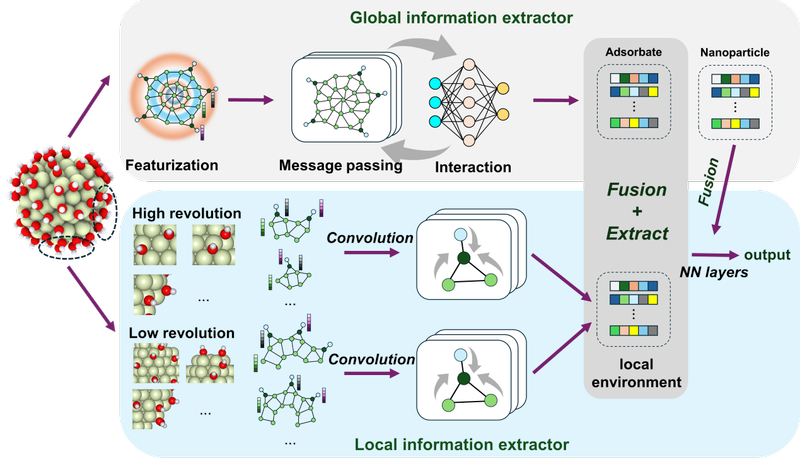
This study proposes a multi-scale neural network framework named ScaleNet, which achieves, for the first time, accurate performance prediction of copper nanoparticle catalysts at the experimental scale. In the field of catalyst design, scientists have long relied on descriptors to correlate the microscopic structure of catalysts with their macroscopic performance. However, conventional descriptors mostly focus on the local information of individual active sites. This paper highlights that for real-world catalysts like nanoparticles, their overall size and morphology, along with their actual surface environment (i.e., the global environment), equally dictate the final catalytic performance. Relying solely on local information is far from sufficient for accurate evaluation. Furthermore, although traditional Density Functional Theory (DFT) calculations are highly accurate, their computational cost becomes prohibitively high, rendering the simulation of experimental-scale nanoparticles containing thousands or even tens of thousands of atoms practically infeasible.
To overcome these challenges, the team adopted a mechanism- and data-driven approach. First, through mechanistic analysis, the team innovatively proposed that surface OH coverage is the key global descriptor determining the CO2 reduction reaction (CO2RR) performance of copper nanoparticles. Next, to compute this global descriptor, the team specifically designed the ScaleNet machine learning framework. The core advantage of ScaleNet lies in its multi-scale learning capability, which ingeniously integrates two key components: a global information extractor and a local information extractor. Through this design, ScaleNet can learn from data of small-sized nanoparticles manageable by DFT and accurately extrapolate to predict the adsorption behavior of large-sized nanoparticles.
The performance of the ScaleNet framework has exceeded expectations. Test results show that its prediction accuracy (R2) reaches over 0.95, and its extrapolation capability on out-of-training-set data significantly surpasses other advanced neural network models such as TensorNet. The most critical breakthrough lies in the fact that the "optimal OH coverage" predicted by the model exhibits a striking linear correlation with multiple sets of published real experimental data.
This result strongly demonstrates the reliability of "optimal OH coverage" as a global descriptor and confirms the powerful predictive capability of the ScaleNet framework. Moreover, the improvement in computational efficiency brought by this framework is revolutionary. For a computational task that would take DFT over 104 days (tens of thousands of days) to complete, ScaleNet requires only about 102 seconds (a few minutes), achieving a 107fold increase in computational efficiency. This work successfully bridges the gap between theoretical calculations of catalysts at the nanoscale and macroscopic experiments. The ScaleNet framework not only provides a novel perspective and a powerful tool for the design of CO2 reduction catalysts but also paves new avenues for the study of other complex catalytic systems (e.g., multi-species co-adsorption).
The first author of this paper is Xiangou Xu, a master's student at Southeast University. Professors Jinlan Wang and Chongyi Ling from the School of Physics, Southeast University, serve as the corresponding authors. This work was supported by the National Key R&D Program of China, the Key Program of the National Natural Science Foundation of China, the Excellent Young Scientists Fund, and other projects.
Link: https://pubs.acs.org/doi/full/10.1021/jacs.5c14012
