

Recently, the research team led by Prof. Wang Jinlan and Prof. Ling Chongyi from the School of Physics at Southeast University has made significant progress in understanding the structure-activity relationships of single-atom catalysts (SACs). Their research findings, titled "Beyond Local Coordination: How Global Structure Engineers the Selectivity of Single Atom Catalysts for CO2 Reduction," have been published in Angewandte Chemie International Edition.
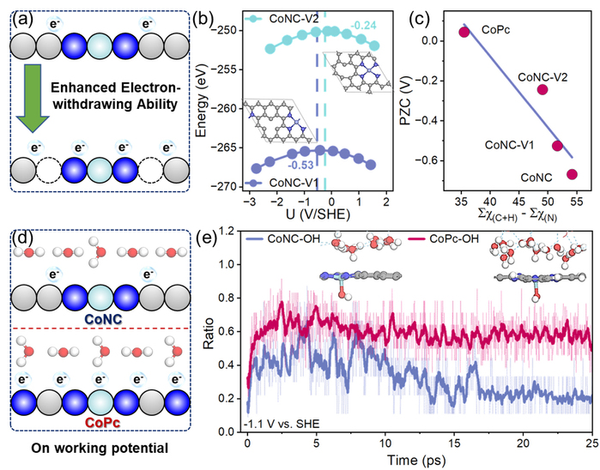
"Structure determines property" is a fundamental principle in material design and optimization. Based on this principle, the local structure of a catalyst-especially the geometric and electronic characteristics of its active center-is traditionally considered the key factor determining catalytic performance. However, in complex catalytic systems, this local structure-dominated relationship often falls short: even with highly similar active sites, catalytic performances can vary drastically.Taking the CO2 reduction reaction as an example, experiments have shown that two types of SACs sharing the exact same CoN4 active center-Co single atoms supported on nitrogen-doped carbon (CoNC) and on phthalocyanine (CoPc)-exhibit completely different product selectivity. CoPc is highly prone to producing carbon monoxide (CO), whereas CoNC predominantly generates hydrogen gas (H2). This phenomenon exposes the inadequacies of relying solely on local structure descriptions, highlighting the urgent need for a new theoretical framework that incorporates "Global Structure" effects to comprehensively understand the regulatory mechanisms of catalytic performance.
To address this issue, the research team combined constant-potential density functional theory (DFT) with ab initio molecular dynamics (AIMD) simulations to systematically explore the electronic structures and interfacial behaviors of CoNC and CoPc. The results demonstrate that although the local active centers of both catalysts are nearly identical in geometry and electronic structure, the differences in their global structures significantly affect the catalysts' potential of zero charge (PZC) and interfacial charge distribution. This, in turn, regulates the electron-carrying capacity and the orientation of interfacial water molecules, ultimately leading to completely opposite selectivity in the CO2 reduction reaction.Further investigation revealed that the strength of the "Global Structure effect" depends on the sensitivity of the local active site to overall structural changes. This study uncovers the limitations of the traditional "local structure determines performance" paradigm and proposes a novel strategy to optimize catalytic selectivity by modulating the global structure of the support (such as introducing carbon vacancies), thereby providing fresh perspectives for the rational design of single-atom catalysts.
Cui Yu, a doctoral student at Southeast University, is the first author of the paper. Prof. Wang Jinlan and Prof. Ling Chongyi from the School of Physics at Southeast University serve as the corresponding authors. This work was supported by the National Key Research and Development Program of China, the National Natural Science Foundation of China and the Fundamental Research Funds for the Central Universities.
Link: https://doi.org/10.1002/anie.202519826
